Polar Animal Facts for Kids: Penguins to Arctic Wolves
Polar animals live at opposite ends of the Earth. In the Arctic, the far north, you will find polar bears, Arctic wolves, Arctic foxes, walruses and seals. Penguins live almost entirely in the southern half of the world, including Antarctica. So a polar bear and a penguin would never meet in the wild. Here are the facts, checked against expert sources.
North or south? Two very different poles
The two polar regions look alike in pictures, but they are built the other way round. The Arctic is mostly ocean, with an ice cover that grows and shrinks with the seasons, close to Europe and North America. Antarctica is an ice-covered continent surrounded by ocean. That one difference shapes who lives where: the Arctic has big hunters that walk on land, while Antarctica has no land predators at all.
Arctic animals: the far north
Polar bear
- The polar bear is the largest land carnivore in the world.
- Under that white coat its skin is black. The fur itself is see-through and only looks white because it reflects light.
- It spends so much of its life on sea ice, and depends so much on the ocean, that it is counted as a marine mammal, the only bear that is.
- Its main food is seals, especially ringed and bearded seals.
- A fact to try on the family: some polar bears live all year round as far south as James Bay in Canada, which sits at the same latitude as London.
Arctic wolf
- The Arctic wolf is not a separate species. It is a subspecies of the grey wolf, and its scientific name, Canis lupus arctos, means "wolf of the Arctic".
- It lives in the Canadian High Arctic, parts of Alaska and the coasts of Greenland, where winter temperatures average around -30°C.
- Its coat stays white all year round. That is one way to tell it from the Arctic fox, whose coat changes with the seasons.
- Arctic wolves live and hunt in family groups, usually of around six to ten.
Arctic fox
- The Arctic fox is the quick-change artist of the north: its fur turns white in winter and becomes a mix of browns and darker colours in summer.
Walrus
- Both male and female walruses have tusks. They are overgrown canine teeth.
- Walruses use their tusks to defend themselves, to hook onto floating ice for a rest and to haul themselves out of the water.
- They feed mainly on shellfish from the sea floor and can dive to around 90 metres to find them.
Antarctic animals: the far south
Penguins
- There are 18 species of penguin and almost all live in the Southern Hemisphere. Only one, the Galápagos penguin, is found north of the equator.
- Of the penguins seen around Antarctica, only two, the emperor and the Adélie, are truly native to the continent itself. Others, such as king, gentoo, chinstrap and macaroni penguins, live on the warmer islands nearby.
- The emperor penguin is the largest penguin. It breeds in the coldest, darkest months of the Antarctic winter.
- An emperor penguin lays a single egg, and the father keeps it warm for around nine weeks without eating, living off his fat reserves.
The Arctic answer to penguins
The Arctic has its own black-and-white seabird: the puffin. Unlike penguins, puffins can fly. You don't need to travel north to see one, either: puffins breed on islands and sea cliffs around the UK coast, which is home to about 9% of Europe's puffins.
Huskies: the dogs of the snow
The Siberian husky comes from north-east Siberia, where the Chukchi people used it for long-distance sledding; it was once known as the Chukchi sled dog. The Kennel Club calls it the lightest and fastest of the sled dogs. In 1925, relay teams of huskies carried life-saving diphtheria serum hundreds of miles to the town of Nome in Alaska, and a statue honouring the dogs stands in Central Park, New York.
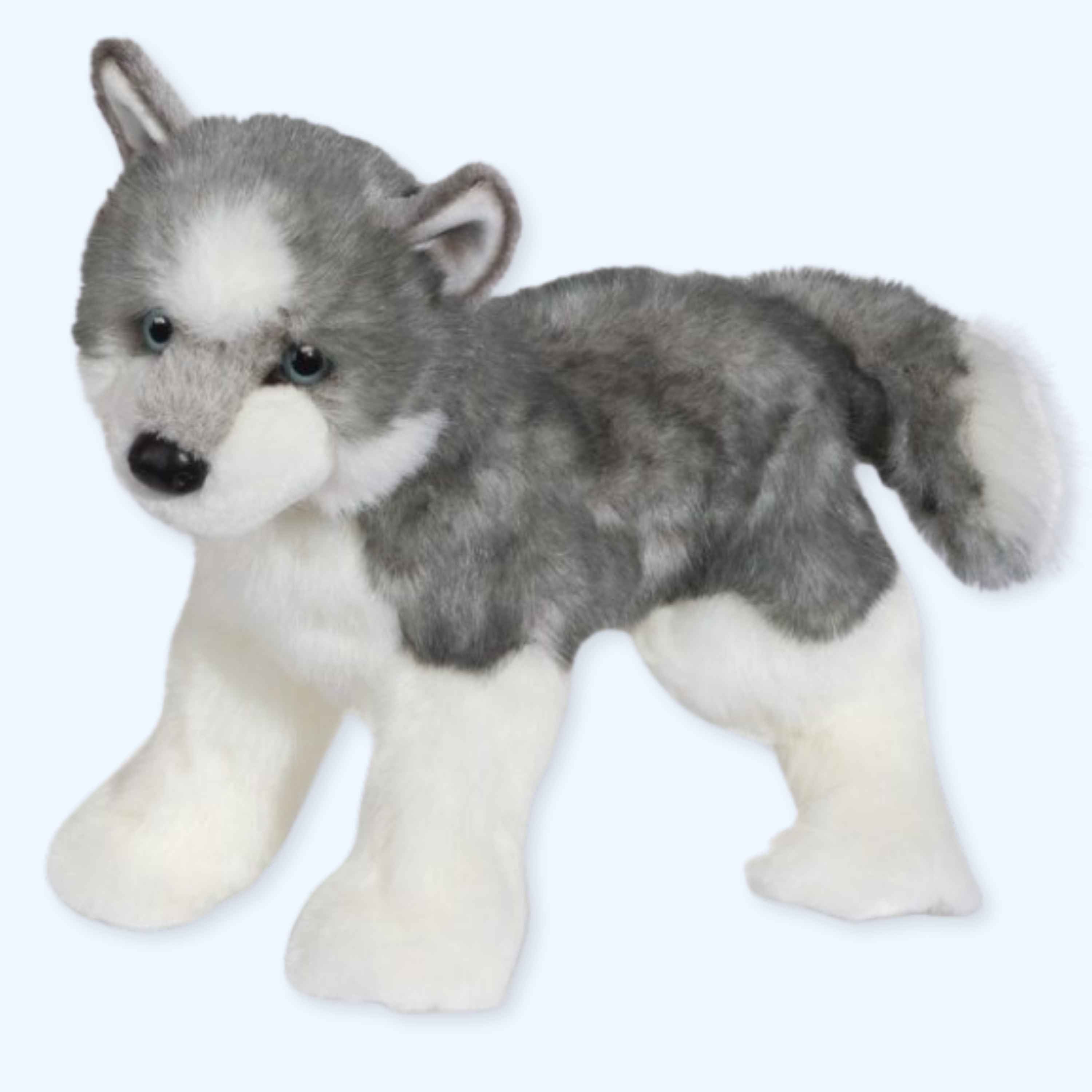
Huskies are domestic dogs, not wolves, but the two look alike enough to make a good matching pair. If your child loves the snowy side of the animal world, our Douglas® husky soft toys include Sasha the Husky, and the wolf and fox collection includes Shadow, a white wolf. For more breed detail, see our guide to Douglas dogs for husky fans.
Play idea: North or South?
Write "Arctic" on one cushion and "Antarctic" on another. Call out an animal and your child carries the right soft toy, or a drawing, to the right pole. Polar bear? North. Emperor penguin? South. Puffin? North, and maybe a quick look at a UK map too. Finish with a bonus round: the Arctic tern, a seabird that spends time at both ends of the Earth on the longest known migration on the planet.
Frequently asked questions
Do penguins live in the Arctic?
No. There are no wild penguins in the Arctic. Almost all penguin species live in the Southern Hemisphere.
Do polar bears eat penguins?
Not in the wild. Polar bears live in the Arctic and penguins live in the south, so they never meet. A polar bear's main food is seals.
Is an Arctic wolf the same as a husky?
No. The Arctic wolf is a wild subspecies of the grey wolf. The Siberian husky is a domestic dog breed developed as a sled dog.
Planning a snowy shelf? Browse Douglas® wolves and foxes in UK stock.